Showing posts with label sand. Show all posts

Tuesday, 28 February 2017

Comments from Sharky! (The Sand)

Hello!


So you have already gathered and analysed the data referring to the sand!
Let's have a look... (Last update 27/03/2017)


Happy to see that all your coordinates are so accurate!

Let's have a look at your data. This is very interesting, you have very colourful beaches!
I have a question for the Col·legi Cardenal Vidal i Barraquer and for the Fenerbahçe College: is the sand made of the same minerals as the surrounding area, or does it come from up the coast?

And what a coincidence, all of you have very small granulometry, so you are getting similar results. By the way, Fenerbahçe College, are you sure you got the size of the heap of sand right when you did the experiment?

Well, I'm afraid that we'll have to wait and see the results of the other participating schools. Hopefully someone will have thicker grain and we'll be able to see the difference it makes!

So please, those that haven't done it yet, send your data! The Sand >>

You are all doing a great job!!!!!

Sharky

PS - update 27/03/2017 Thank you South East High School for your data! I'm afraid that one of the objectives of this section is to let you see the effect of different granulometry on the shape of the beaches, but all of you have the same type of sand! Basically the thicker the sand, the steeper the beach front is. Also nourished beaches act as if they were of thicker sand because there's a mixture of all kinds of sizes of grain due to the human action. So these beaches are also steeper than a natural beach of the same granulometry. WELL DONE!

Monday, 6 February 2017

The Sand (activity 3)

Hello!


Happy to see all of your presentations and congratulations to those that you have already sent the water information. As soon as all participant schools have sent their data, I will put up a table where you will be able to compare the results. I can't wait to see it!!!

In the meantime we are moving on to the next activity.


Activity nº 3: The Sand
Objective: complete the form The Sand >>

Source of data:
  • Survey (you have already done)
  • Experiments in the classroom
  • Internet
(Teachers will supply you with the information about the experiments and webpages)

Deadline to complete the form: 20th February
Please remember only one form per class!

Also I would love to see what the beach you are studying looks like!  Please post some photos along with the name of the beach, town and GPS coordinates and the graph of the monthly average Sea Surface Temperature. (Label: water). Thank you!!!


All the best!

Sharky

Monday, 9 May 2016

THE SAND


 The sand composition of Cala Sant Francesc (also named Cala Bona)
 we have founded ...


Volume

General shape of the clasts


gravel
sand
fine soil
angular
subangular subrounded rounded
Organic structures remains
(shells, sea urchin quills...);
they react with H Cl
bioclasts *
x
x
x


x


x


Pink, white, orange colors
bright, round,
they react with H Cl
calcite


Dark and bright,
it is easily broken with the needle
biotite


Dark ,
it does not break easily with the needle
rare earth
minerals

x


x
Colourless, white or grey
often it has flat surfaces,
it seems glass
quartz

x


x
Fragments formed several minerals with different colours rock fragments
x
x


x


Pink colours amd matt


orthoclase

x


x


                                                      note:   there was some gravel size of rock fragments.
                                          data table adapted from the book CTMA-I Castellnou Edicions, BCN 2003
   
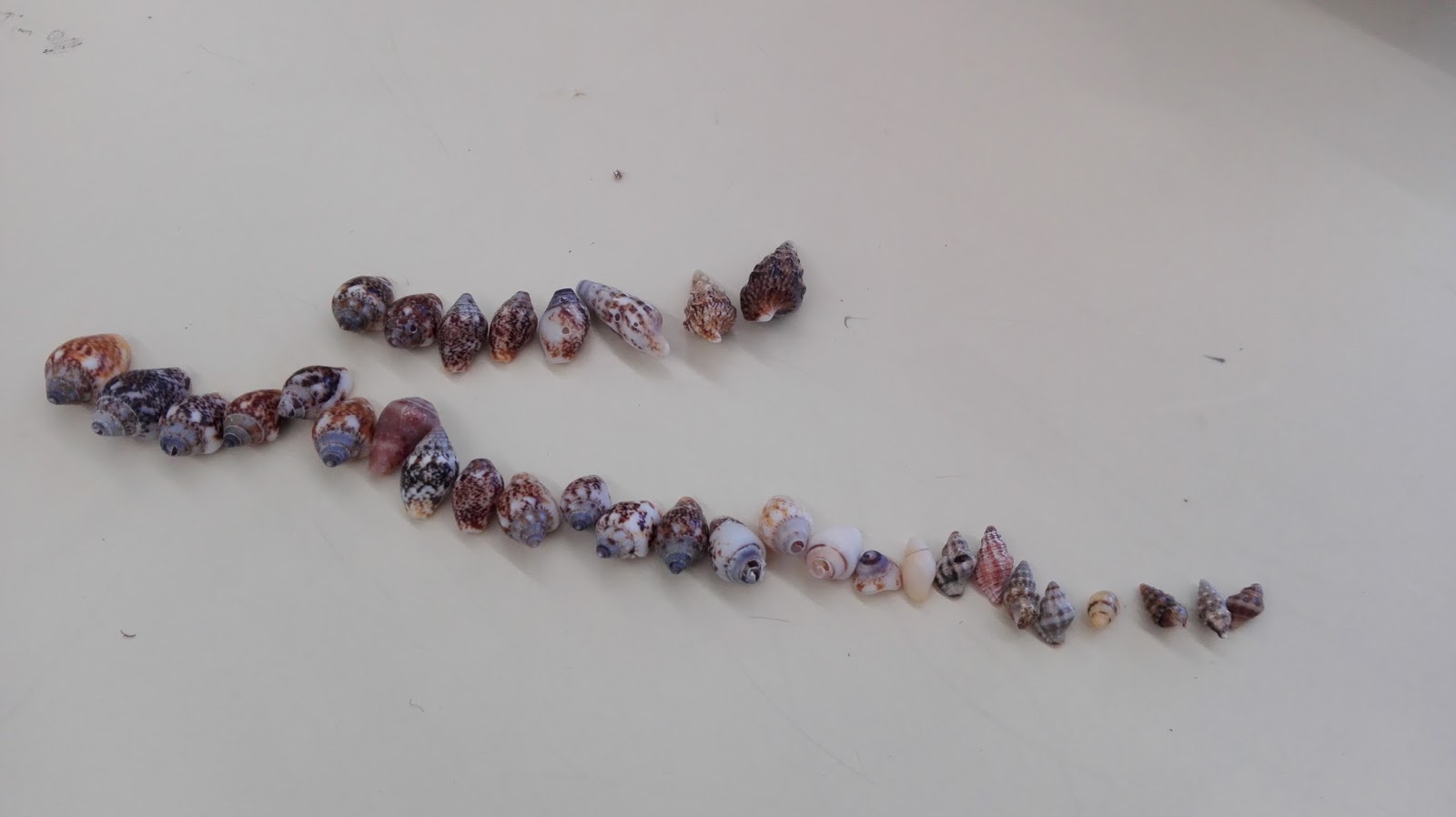
The sand has other particles* such as...
we have founded ...

3-remains of algae

1- corall remains  2-molluscs 
4-smalls crabs and sea urchin
5- sea snails


Height and diameter of a hep of sand
After making the funnel, we have poured the sand through it twice. We have put a piece of absorbent paper underneath, in order to prenent sand grains from spreading over the taeble, what had happened the first time we had tried it. Finally, we have measured it with a tape measure.


  The longshore drift and the man-made structures


<http://vle.caldew.cumbria.sch.uk/pluginfile.php/7497/mod_resource/content/0/Untitled.jpg>


adapted from the anterior 

It alter the shape of beaches because the sand can not do  (//) the lateral displacement  and piles up on one side of the man-made structure.


Nanou, Guillem, Pau and their teacher have decided to try to improve performance ... and we believe they have got it.

Height and diameter of a heap of sand

1· We measured 1L. of sand with a calibrated container.


2· We made a funnel with a corner of a Tetra Pak making a hole of 2.5 cm. in the longest side.


3· We fixed the funned to the support and the funell at 40 cm. high.


4· We put a metallic tray under the brick and the support , and two kitchen papers on top to collect better the sand and prevent the grains from bouncing. We put the tray onto a cardboard box.


5· We throw the sand slowly to obtain a mountain.


6· We get a mountain of 5 cm. height with a base of 15 cm.


1·Vam mesurar amb una gerra mesurada una quantitat de 1 L. de sorra
2·Vam fer un embut amb l'angle d'un "tetrabrick" que tenia una obertura de 2.5 cm. al cantò més llarg.
3·Vam fer un muntatge amb el suport i el "brick" fent d'embut a 40 cm. d'altura
4·A sota vam posar una safata metàl·lica amb les vores una mica aixecades i dos papers de cuina al damunt per així recollir millor la sorra i evitar que reboti, vam obrir una capsa i ho vam posar també al voltant per tal de que no s'escampes la sorra.
5·Vam tirar la sorra a poc a poc per tal de que es crees una muntanya.
6·Vam obtenir una muntanya de 5 cm. d'alçada amb una base d'uns 15 cm.


Granulometria

To know what is the structure of the sand, we used calibrated sieves we had in the lab and then we obtained the following results:

Per tal de conéixer quina es l'estructura dels grans de sorra, vam aprofitar els tamisos calibrats que teniem al laboratori  i vam obtenir els següents resultats:


1· We sized 1 liter of sand.
2· We measured it in the balance with the metalic tray included; remaining the weight of the tray we get the net weight.
3· Net weight = Gross weight - Tare = 1930,4 g. - 306,2 g. = 1624,1 g.
4· We obtained the density of the sand :D=M/V = 1624,1 g./1000 cm3 = 1,624 g/cm3
5· We ordered the sieves by sizes, the sieve which had the mesh opening more biggest (2mm), then the 1mm and then the 0.8mm.


1·Vam mesurar un litre de sorra
2·Vam pesar-lo a la balança amb la safata inclosa; restant el pes de la safata vam obtenir el pes net.
3·Pes net = Pes brut - Tara = 1930,4 g. - 306,2 g. = 1624,1 g. 
4·Vam poder trobar la densitat de la sorra : D=M/V   =  1624,1 g./1000 cm3   = 1,624 g/cm3
5·Vam ordenar els tamisos per mides; el que tenia la obertura malla més gran era de 2 mm. , desprès el d'1mm. , el de 0.8mm.


Net weight of the fraction
Percentage
Sand > 2mm.
1492,8 g.
91,47 %
Sand < 2mm. > 1mm
125,6 g.
7,73 %
Sand < 1mm. > 0,8mm
5,2 g.
0,47%
Sand < 0,8 mm
0,5 g.
0,32 %
Total
1624,1 g.
100%


Monday, 25 April 2016

Comments from Sharky! (The Sand)

Hello!


So you have already gathered and analysed the data referring to the sand!
Let's have a look... (updated 17th May)


Happy to see that all your coordinates are so accurate!

Let's have a look at your data. This is very interesting, you have very colourful beaches!
Now, by looking at the table try to finish the sentence:
(1) The coarser the sand is the .............. (steeper/flatter) is the slope of the beach face.
(2) Can you tell why?

All participating schools are invited to answer on this same post, just press on the 'No comments/comments' link!

And you can send your data if you haven't done it yet! The Sand >>

Looking forward to your comments!!!!!

Sharky


Monday, 18 April 2016

Hi fishes,

It was awesome to work about the sand last week in Bot cove. Do you remember us? We are octopus.


Let's continue enjoying Oceans.
Hello mates,

 Here we are, 1st ESO E, enjoying Platja Cristal during the survey of "the sand" two weeks ago. ;-)


See you soon. Jellyfish.

Monday, 4 April 2016

The Sand (activity 3)

Good morning!

Congratulations to those that you have already sent the information. As soon as all participant schools have sent their data, we will put up a table where you will be able to compare the results.

In the meantime we are moving on to the next activity.


Activity nº 3: The Sand
Objective: complete the form The Sand >>

Source of data:
  • Survey (you have already done)
  • Experiments in the classroom
  • Internet
(Teachers will supply you with the information about the experiments and webpages)

Deadline to complete the form: 18th April
Please remember only one form per class!

We also want to remind that we would like you to post the photos of the beach you are studying along with the name of the beach, town and GPS coordinates. (Label: water)

All the best!

The S'Agulla Team

Tuesday, 1 December 2015

Comments from Sharky! (The Sand)

Hello!!!
So you have already gathered and analysed the data referring to the sand! 
Let's have a look....


IES Tres Turons 1C I am afraid you have not gone over your GPS coordinates yet, they are still of a point inland... And Ins Puigcargol I just hope that all the sand is from the same beach. Remember that when doing research it is very important to know where the data comes from!

Ok, now let’s relate the granulometry with the height and diameter of your heap of sand. Does finer sand make taller or flatter heaps? Do you think that wind and waves will move the sand in different ways depending on the size of the grains?
You have not observed differences in the inclination of the slope of the beach face. But thinking on your results of the experiment, which beach do you think will have a steeper slope?

I see that the main factor that brings sand to the beach is rivers from the mountains nearby. But IES Tres Turons 1D adds that the Tordera River, which is further north, also brings sand. What process brings the sand from the Tordera to Picòrdia beach of Arenys de Mar? 

If you get the answer to the last question, you will also be answering the questions of the water!!!
Come on, think about it. All students from all the schools can suggest an answer!

Looking forward to your comments!!!!

Sharky


Friday, 6 November 2015

The Sand (Activity 3)

Good morning!

Congratulations to those that you have already sent the information. As soon as all participant schools have sent their data, we will put up a table where you will be able to compare the results.

In the meantime we are moving on to the next activity.


Activity nº 3: The Sand
Objective: complete the form The Sand >>

Source of data:
  • Survey (you have already done)
  • Experiments in the classroom
  • Internet
(Teachers will supply you with the information about the experiments and webpages)

Deadline to complete the form: 16th of November
Please remember only one form per class!

We also want to remind that we would like you to post the photos of the beach you are studying along with the name of the beach, town and GPS coordinates. (Label: water)

All the best!

The S'Agulla Team